
Donna Tartt’s Writing Process
and, plausibly, that of many other writers.

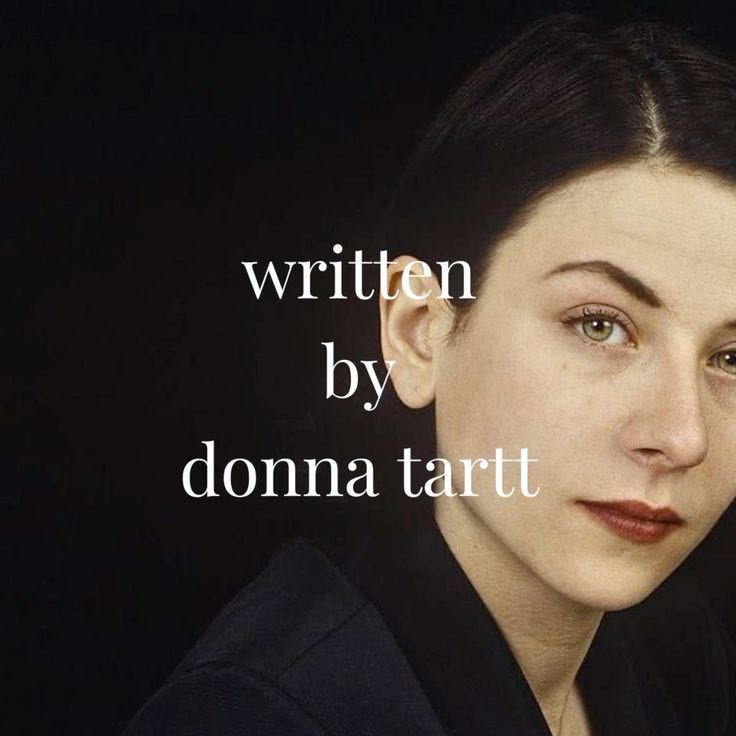
“Writing a book is a deeper level than reading a book. It’s really fun, sometimes it’s difficult, it’s hard, but when it’s good and it goes well there’s nothing better.”
These are, more or less, Donna Tartt’s words about writing. One of the most incredible writers of all time, Tartt is famously solitary, completely absent from social media platforms and very reluctant to give interviews.
Her books, intellectual to the point of exhaustion, are perfectly crafted in every single detail, and this is what makes them true masterpieces.
I remember the first time I read The Secret History: the book was certainly already well known, but it had not yet achieved its current level of media attention. I found a copy at a used book stall and bought it for just a few coins.
When I read it, I remember thinking I had discovered a buried treasure, a small gem to be carefully guarded. I felt it was a real privilege to have found it and wanted to keep my discovery to myself.
Only much later did I find out that Donna Tartt was an award-winning and exceptionally famous author, especially in the United States.
Adding an extra layer of mystery (at least from my point of view) to her figure was the fact that she had published very few books.
And it is precisely from this point that my reflection begins: her works are so masterfully constructed that they require a considerable amount of time to be written, generally around ten years.
For this very reason, in this article I want to investigate her writing process, in order to understand the deep structures hidden behind her words and her characters.
This post is the second in the series “The writing process of… and plausibly that of many other writers.”
Don’t miss the previous post on Sylvia Plath’s writing process.
Sylvia Plath writing process
Originally from Greenwood, in 1982 she attended the University of Vermont, where she met Bret Easton Ellis, a close friend (and another remarkable writer).
Her university experience was decisive for her life and her formation. Her group of friends would become a major source of inspiration for her first novel, The Secret History, published in 1992 and enthusiastically received by both the public and critics.
From a young age, she recounts in a well-known 1992 interview, she had always loved reading deeply and had immediately tried her hand at writing poetry (which, by her own admission, she was not very good at, because emotions appeared to her in the form of stories) as well as short stories — another genre she did not feel entirely comfortable with, as it offered only a glimpse into her characters’ lives.
She was formed as a reader by Dickens and Mark Twain, Eudora Welty and Faulkner.
She also spoke of rereading her favorite books very often, because during a first reading you are searching for the story itself, whereas with a second reading you can truly study the book and observe the structures it conceals.
As for her initial approach to a work, Tartt explained in a 2017 interview with Dazed Digital that she writes the first draft of her projects entirely by hand: pages and pages of notes written in red and blue pen, accompanied by a substantial number of post-it notes for further reflections.
Only after building the framework of her world and her characters does she move on to digital writing.
I find myself quite in agreement with this system: when I want to write a more complex story than usual, I too prefer writing by hand. I find that words flow more easily from my pen than from my fingers.
In the same interview, she also mentioned having spent much of her time writing The Goldfinch at the New York Public Library: writing in a public place does indeed have its advantages — “if you need a character, all you have to do is look around.”
In another interview from 2021, published by Rivista Studio, she provides further details:
“I write for three hours in the morning: if it’s not going well, I stop and do something else, but if it is going well I work until I’m tired… I like working in quiet rooms. City noise doesn’t bother me, but I can’t stand hearing the television. I can really work almost anywhere.”
She then explains that she is capable of writing late into the night if the day is good and creative, but if it is not, she closes her work and devotes herself to something else.
Her writing does not follow commercial guidelines: it is free, driven by impulses and passions completely independent from market logic. This is what makes her work so astonishing. I believe one can feel, in every sentence, the strong desire to write it, the immense care invested in its creation.
She also recounts that, at the end of a day entirely devoted to writing, all she wants is to pick up the book she is currently reading and spend the evening immersed in it. Reading is a pleasure for her, and for this reason she chooses her books with great care. Often they are texts that connect thematically with her own work, from which she can draw inspiration.
Perhaps this is what Donna Tartt’s writing process teaches us more than anything else: slowness is not a flaw, but a form of respect. For stories, for characters, for readers — and for writers themselves.
In a time that demands speed, constant exposure, and continuous production, choosing to take years to build a book becomes almost an act of resistance.
Tartt’s novels are not born to chase the market, but to endure. And perhaps that is why, once we enter her pages, we never truly leave them.
Please let me know which other author’s writing process you would like to learn about.
With love,
Viv.
I liked the idea that writing by hand can open a different kind of thinking. There’s something about the physical act of writing that slows the mind down just enough to let ideas develop more organically.
i’m about ¾ of the way through secret history and just so impressed with her skill as a novelist. i haven’t been so immersed in a book in years! i will definitely want to reread it to study her storytelling to inform how i could write novels in the future. it was super interesting to read about her process and solitary nature as an author. thanks for this post!